Cosmic voids
- Period
- 2009 — present
- Questions
- What is the equation of state of dark energy?
What is the energy budget of the Universe? - Pipelines
- VIDE (maintained), ZOBOV, BORG antihalos
- Data
- SDSS-II, SDSS-III/BOSS, 2M++, Euclid (forecasts)
- With
- B. Wandelt, P. M. Sutter, N. Hamaus, S. Stopyra, R. Malandrino, J. Jasche
Cosmic voids are large expanses of space that contain very few galaxies. They are the opposite of clusters, which are dense regions of space containing many galaxies. The fact that they are so empty makes them useful for cosmology. Their low density makes them dynamically simpler to model than clusters, they become dark-energy dominated far earlier, and they give more direct access to the information held in the initial conditions. This could make them great laboratories to study two fundamental cosmological questions:
- What is the equation of state of dark energy?
- What is the energy budget of the Universe?
Cosmic voids also have real drawbacks: they are enormous, so exploiting them needs galaxy surveys with wide coverage, and unlike clusters their measured properties depend appreciably on the definition used to identify them. Both of the questions above can be answered with voids, but only once that definition is pinned down.
Detection and characterisation
- 2010Lavaux & Wandelt — void dynamics from MAK displacement fieldsDOIarXiv
- 2012Lavaux & Wandelt — the Alcock–Paczyński test on void shapesDOIarXiv
- 2015Sutter et al. — VIDE, the public identification pipelineDOIarXiv
The two questions call for two different kinds of structure. The first needs regions that are demonstrably expanding, together with a way to quantify that expansion locally in space and in time; the second needs voids used as purely geometric tracers of the expansion. Together with Benjamin Wandelt, we set out the two approaches in a pair of founding papers.
The first paper showed that the displacement field recovered by the Monge-Ampère-Kantorovich reconstruction (MAK, Brenier et al. 2003) is entirely sufficient to characterise void dynamics down to scales of 5 Mpc/h, and that exceptional constraints on the dark energy equation of state follow — at the price of assuming a constrained model of the cosmic expansion.
 Enlarge
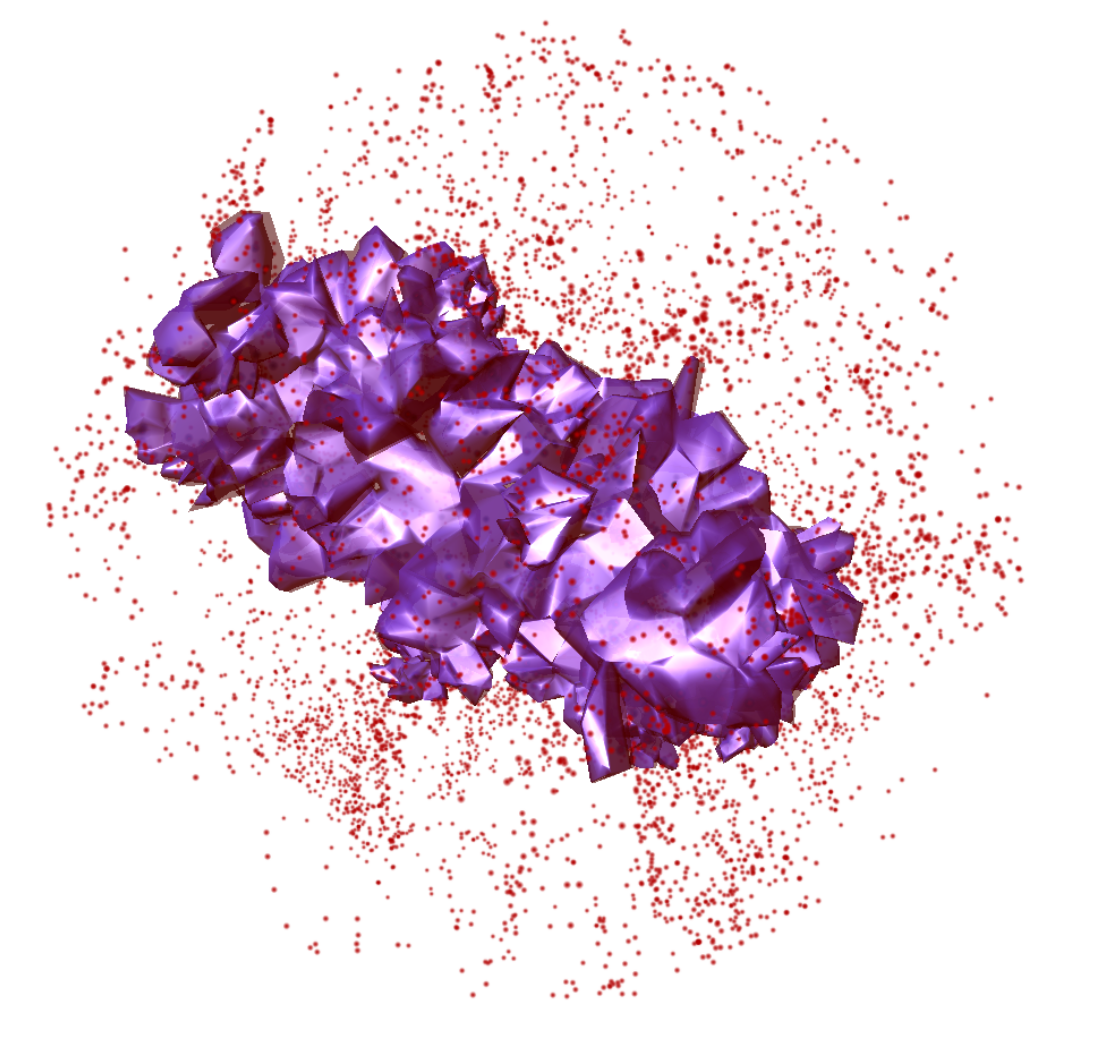
An example of a void identified using the VIDE pipeline, the red dots represent the SDSS galaxies while the purplish surface is the limit of the identified cosmic void. The image was rendered using home-grown visualisation software.
The second paper built a pipeline on top of the ZOBOV watershed algorithm (Neyrinck 2008) that measures how void shapes are deformed when the wrong coordinate system is used to represent them. Adjusting the cosmology until the coordinate system is right turns that deformation into a measurement. This paper contributed to the emergence of a whole subfield, largely because the identification and characterisation pipeline was distributed rather than kept in house: it became VIDE, which I occasionally still maintain, while Paul Sutter does most of the job now.
Modelling and cosmological constraints
- 2012Sutter, Lavaux, Wandelt & Weinberg — the first public void catalogueDOIarXiv
- 2016Hamaus et al. — cosmology and gravity from void dynamicsDOIarXiv
- 2020Hamaus et al. — parameters from the final BOSS data, without BAODOIarXiv
- 2022Hamaus et al. — forecasts for the Euclid spectroscopic surveyDOIarXiv
- 2022Contarini et al. — the void size functionDOIarXiv
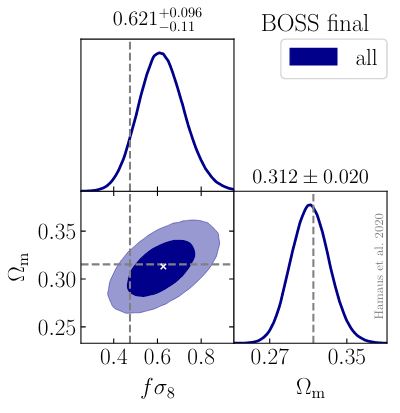
In the end cosmic voids are not as simple as they first appear when trying to account for survey systematics. A long list of details may turn into systematic error on the recovered parameters, both about the voids themselves and the cosmological parameters. The group spent several years establishing a procedure that accounts for them. Those techniques measured cosmological parameters faithfully and precisely first in mock surveys and then in the SDSS-II and SDSS-III/BOSS observations, without relying on the BAO method at all.
 Enlarge
Cosmological parameters measured from the mean shape of voids at a given redshift, in the final BOSS sample. Filled contours are 68.3 % (dark) and 95.5 % (light); dashed lines mark the Planck 2018 cosmology, and the marginal distribution of each parameter is shown alongside. From Hamaus et al. 2020.
A large group led by Alice Pisani and Nico Hamaus took the void cosmology programme further, and is now an official Key Programme within the Euclid Consortium. The group has produced a series of papers that produced the forecast constraints obtainable from the Euclid wide spectroscopic survey, later extended by a study dedicated to the void size function. They are working hard to produce the first cosmological constraints based on Euclid survey data.
Voids at the field level
- 2024aStopyra, Peiris, Pontzen, Jasche & Lavaux — joint cluster and void masses from BORG posteriorsDOIarXiv
- 2024bStopyra et al. — 150 antihalo voids across the local supervolumeDOIarXiv
- 2026Malandrino, Lavaux, Wandelt, McAlpine & Jasche — 100 high-significance voids from ManticoreDOIarXiv
Since 2023 the programme on cosmic voids has changed scale. Rather than running VIDE alone on observed catalogues, the programme now works directly from the constrained Bayesian simulations described under BORG and Manticore, and characterise voids and clusters at the level of the field itself.
We moved to this approach because the voids identified in observed catalogues are not the same as the voids in the underlying matter field. The former are defined by the distribution of galaxies, which are biased tracers of the matter field, and the latter are defined by the distribution of matter itself. The two sets of voids are related, but not identical. By working directly with the matter field, we can identify voids that are more closely related to the underlying physics, and we can also identify voids that are not visible in the galaxy distribution. This allows us to study voids in a more fundamental way, and to use them to constrain cosmology more robustly. We also gain access to the full posterior distribution of voids, which allows us to quantify the uncertainty in our void measurements and to propagate that uncertainty into our cosmological constraints.
S. Stopyra et al. first showed how to infer cluster and void masses jointly from the posterior realisations, then built a catalogue of 150 antihalo voids covering the whole local supervolume. The antihalo voids are defined as the voids in the distribution of antihalos, which are the negative of the halos in the matter field. They are a useful tool for studying voids because the definition is less ambiguous by relying on a standard halo identification procedure. They should closely follow the voids of the original initial conditions. The disadvantage is that you are relying on a completely different void finder, which cannot be related to any other past work.
We pushed that approach further in Rosa Malandrino's thesis, which produced a Bayesian catalogue of 100 statistically high-significance voids in the local Universe from the Manticore constrained simulations (Malandrino et al. 2026, website). The catalogue is based on VIDE void finder, but applied to an ensemble of posterior realisations of the halo field.