BORG
- Full name
- Bayesian Origin Reconstruction from Galaxies
- Period
- 2012 — present
- Question
- What were the initial conditions that produced the Universe we observe?
- Role
- Principal architect of the code
- Built with
- C++, hybrid OpenMP/MPI, Python and Julia bindings
- Data
- 2M++, SDSS-III/BOSS, Euclid (in preparation)
- With
- J. Jasche, F. Schmidt, N. Porqueres, T. Charnock, D. Kodi Ramanah, S. Ding, H. Desmond
- Code
- ARES/BORG public release, and the software page
Every large cosmological survey faces the same interpretation problem, whether it observes galaxies, the cosmic microwave background, line intensity or the Lyman-α forest. The observations are contaminated by foregrounds. The survey is cut into pieces, because parts of the sky are inaccessible or too contaminated to use. The relationship between the underlying physical quantity, nearly always the dark matter distribution, and the effect actually measured is non-linear. For example, the buildup of a galaxy is a very non-linear process involving primarily the formation of a dark matter halo, and then extremely complicated physical processes to create stars and accumulate gas in different states. This underlines the deep problem facing cosmology: nobody has real control over the relation between the distribution of matter, baryonic or dark, and the images a telescope records.
Since 2012, a handful of international collaborators and I have worked on a far more direct answer to this. Rather than compressing the data into summary statistics and comparing those to theory, we model the whole chain forward, from the initial conditions, through structure formation, to the observed catalogue including its defects, and infer the field itself.
The model
- 2011Lavaux & Hudson — the 2M++ catalogueDOIarXiv
- 2015Jasche & Lavaux — matrix-free large-scale Bayesian inferenceDOIarXiv
- 2016Lavaux & Jasche — the 2M++ catalogue through Bayesian eyesDOIarXiv
- 2019Jasche & Lavaux — full N-body forward modelDOIarXiv
BORG embraces the complexity of the observations instead of averaging it away. It fits the value taken by the density field in every one of a large number of small volume elements, producing realisations of the matter density field constrained by the data.
What separates it from a classical galaxy-survey analysis is that the evolution is modelled non-linearly. The initial gravitational fluctuations seeded by inflations are generated as Gaussian and linearly transformed to post-recombination. Those new fluctuations are then evolved forward into the large-scale structure observed at low redshift. Those structures have N-point statistics that no analytic description captures. With Jens Jasche, we developed the algorithms first in the linear regime, then applied them to the 2M++ catalogue. We used Lagrangian perturbation theory for structure formation, followed by an empirical model relating matter to the spatial distribution of galaxies. More recently a full N-body simulator in place of the perturbative treatment.
 Enlarge
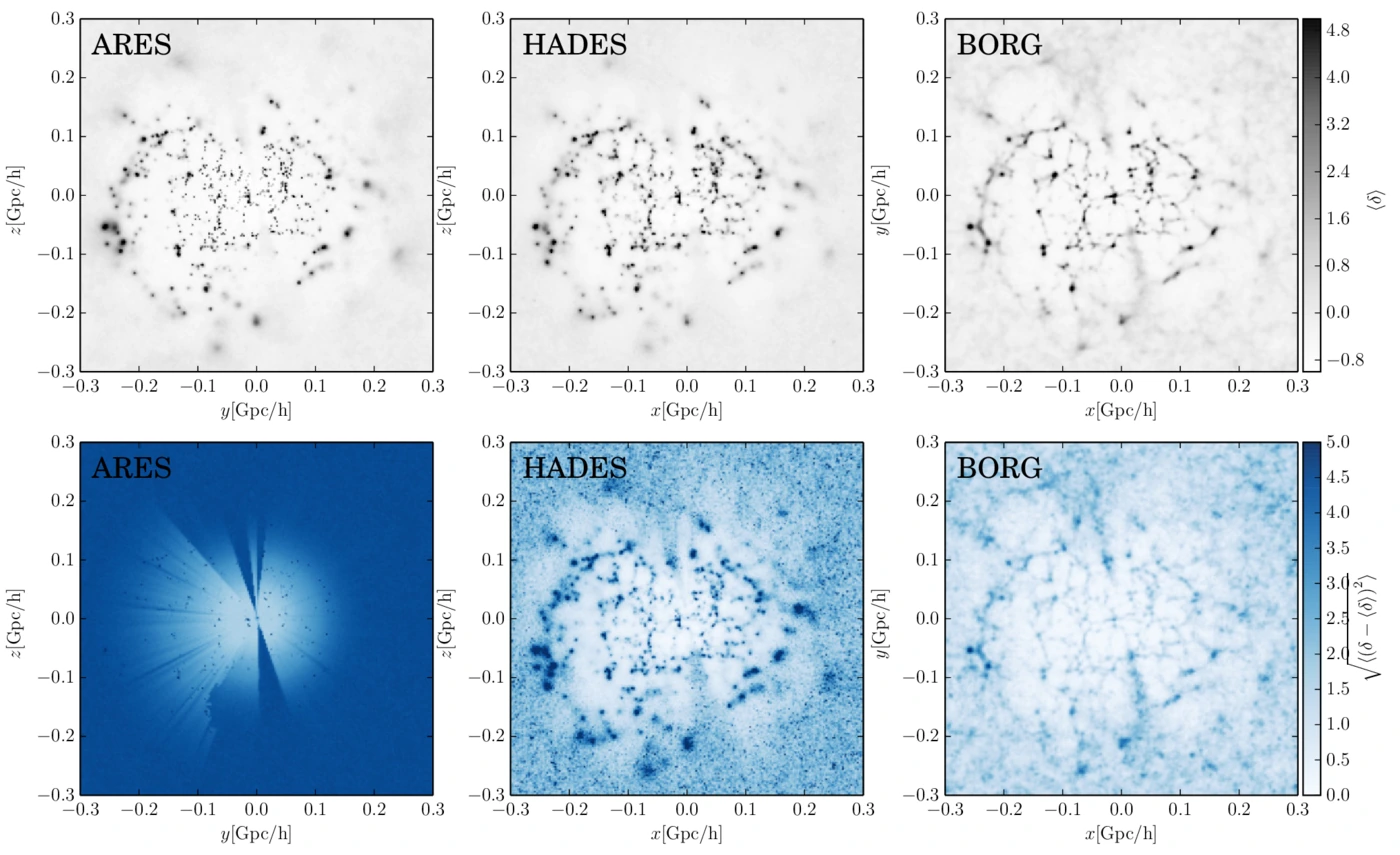
Three structure-formation models fitted to the same data, the 2M++ survey. Left to right: linear theory (ARES), a log-normal transformation (HADES) and Lagrangian perturbation theory (BORG). The top row is the mean inferred density field, the bottom row its standard deviation. Using a physical model recovers the filaments, which the simpler models miss entirely; the leftmost panel looks sharp but its uncertainty map shows that the apparent precision is misleading.
We tested the different models on the 2M++ catalogue (Fig. 1), and found that the
physical model recovered the filaments of the cosmic web, which the simpler
models missed entirely. The other models looked sharp, but their uncertainty
maps showed that the apparent precision was misleading. We also computed evidences for three models
and found that the more physically grounded were decisive through evidence computation.
Systematics and robustness
- 2017Jasche & Lavaux — foreground and target contaminationDOIarXiv
- 2019Porqueres, Kodi Ramanah, Jasche & Lavaux — unknown foreground contaminationsDOIarXiv
- 2019Lavaux, Jasche & Leclercq — systematic-free inference from SDSS3-BOSSarXiv
- 2019Schmidt, Elsner, Jasche, Nguyen & Lavaux — a rigorous EFT forward modelDOIarXiv
- 2020Schmidt, Cabass, Jasche & Lavaux — unbiased inference from biased tracersDOIarXiv
- 2020Charnock, Lavaux, Wandelt, Sarma Boruah, Jasche & Hudson — neural physical enginesDOIarXiv
- 2019Kodi Ramanah, Lavaux, Jasche & Wandelt — joint expansion and density inferenceDOIarXiv
A more accurate model makes the treatment of systematics more important, not less. BORG can encode almost anything, at the cost of extra computation. The first target was multiplicative foregrounds, which typically models absorption of photons by dust, or fibre collisions preventing the observation of galaxies too close together on the sky. I led the development of two complementary approaches to this class of problem, differing in how much has to be assumed in advance about the systematics maps; both were demonstrated on mock and real catalogues.
The other major systematic is the galaxy bias function, which has to be robust enough that cosmological parameters survive it. With T. Charnock (postdoc) and S. Ding (PhD student), the group found a promising parameterisation derived from halo abundance. Separately, with D. Kodi Ramanah, we built a model of the cosmic expansion into BORG so that it is inferred jointly with the density field; tested on mock catalogues, this divides the error bars on Ω_m and w₀ by a factor of ten compared with a classical BAO analysis.
2M++ and SDSS-III/BOSS
- 2019Jasche & Lavaux — cluster mass profiles and velocity vorticityDOIarXiv
- 2018Desmond, Ferreira, Lavaux & Jasche — fifth force from galaxy mass componentsDOIarXiv
- 2019Desmond, Ferreira, Lavaux & Jasche — the fifth force in the local cosmic webDOIarXiv
- 2019Lavaux, Jasche & Leclercq — SDSS-III/BOSS, z = 0 to 0.7arXiv
- 2021Mukherjee, Lavaux, Bouchet et al. — correcting H₀ from gravitational wavesDOIarXiv
- 2021Porqueres, Heavens, Mortlock & Lavaux — forward modelling cosmic shearDOIarXiv
- 2022Porqueres, Heavens, Mortlock & Lavaux — lifting weak lensing degeneraciesDOIarXiv
- 2022Bartlett, Desmond, Ferreira & Jasche — dark matter annihilation and decayDOIarXiv
- 2022Tsaprazi, Jasche, Lavaux et al. — intrinsic alignment from SDSS-III BOSSDOIarXiv
Applied to 2M++, the method gives reliable mass profiles for clusters across a whole volume in a single reconstruction, with no particular artefacts in the recovered matter fields, and access to quantities that cannot be observed directly at all — the vorticity of the velocity field among them.
The same reconstructions constrained fifth-force theories of gravity, both on the Compton length, around 1 Mpc/h, and on fluctuations of the gravitational constant at those scales. Analysing two distinct effects, the team was surprised to obtain significantly non-zero constraints in both cases; a new series of numerical simulations is under way to confirm or rule that out.
The application to SDSS-III/BOSS gives a unique view of the evolution of the Universe from z = 0 to z = 0.7 — more than 6.4 billion years — and, as a by-product, maps of the systematic effects still present in the data and otherwise unaccounted for.
The same machinery has since been carried well outside its original setting. Generalised to cosmic shear surveys under Lavaux's supervision, field-level inference could shrink the error bars on some cosmological parameters by a factor of five. It has also produced constraints on the physics of dark matter itself, and on the intrinsic alignment of galaxies — a contaminant of weak lensing that this approach can model rather than marginalise away.
Constrained resimulations
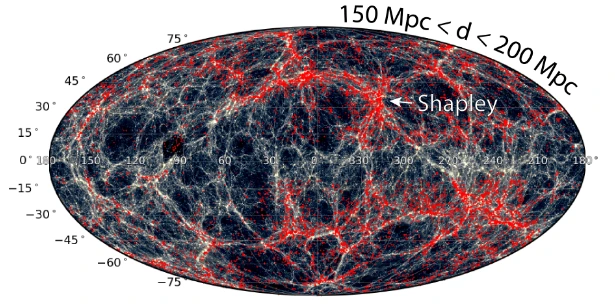
A reconstruction is a statement about initial conditions, so it can be handed to a simulation code and run forward at whatever resolution you can afford. That is the SIBELIUS programme, in which Lavaux took part: full N-body resimulations of the local Universe whose initial conditions come from applying BORG to the 2M++ catalogue.
 Enlarge
The shell between 150 and 200 Mpc. In greyscale-blue, the SIBELIUS-DARK simulation, whose initial conditions were derived from the 2M++ catalogue by BORG; in red, the observed 2M++ galaxies. The Shapley concentration is marked. The simulated filaments and the real galaxies land in the same places, which is the whole claim.
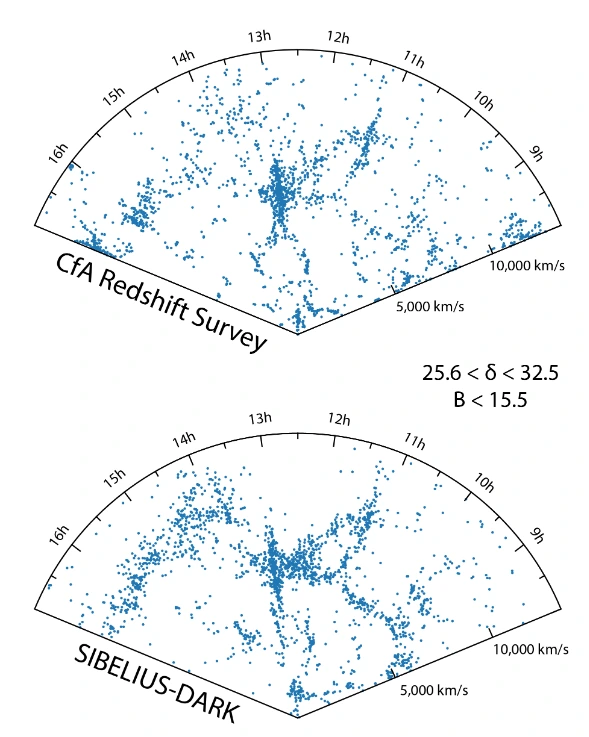
The sharper test is to compare like with like: take a survey that was never used to constrain the reconstruction, and see whether a simulated catalogue built the same way reproduces it.
 Enlarge
The same region of sky, to the same depth and the same selection: the CfA Redshift Survey above, and below it galaxies simulated with GALFORM inside SIBELIUS-DARK. The Coma cluster and the filaments around it appear in both. From McAlpine et al. 2022.
Manticore, which is where this line of work now lives, has its own page.
Code and statistics
- 2021Lavaux, Jasche & Leclercq — inference through implicit cross-correlation statisticsarXiv
Lavaux is the principal architect of BORG, written in C++ with bindings to Python and Julia and a hybrid OpenMP/MPI parallelisation. The design goal is a differentiable simulation machine that is fast, runs at scale, and depends on as little external software as possible.
On the statistical side, the search continues for likelihood functions that make cosmological inference robust. One result worth singling out: a likelihood that removes any sensitivity to a linear bias whose value depends on scale, with encouraging consequences for the recovered parameters.
Surveys
- 2023Andrews, Jasche, Lavaux & Schmidt — forecast for field-level primordial non-GaussianityDOIarXiv
- 2025Euclid Collaboration; Mellier et al. — the mission overviewDOIarXiv
- 2025Euclid preparation LXXVI, Monaco et al. — thousands of simulated spectroscopic skiesDOIarXiv
- 2026Euclid preparation LXXXIII, Risso et al. — redshift interlopers in the two-point functionDOIarXiv
- 2026Euclid Collaboration; Andrews, Jasche, Lavaux et al. — field-level primordial non-GaussianityDOIarXiv
This work became considerably more pressing with the arrival of Euclid data. Lavaux contributes to the GC-SWG, the Theory-SWG and the SIM-WG: simulating thousands of Euclid spectroscopic skies, controlling the angular systematics of the spectroscopic survey, and quantifying the impact of redshift interlopers on the two-point correlation function.
The Theory-SWG and GC-SWG programme has now moved past preparation. The collaboration's large paper on the field-level inference of primordial non-Gaussianity and of the initial conditions is a direct continuation of the 2023 forecast paper. Lavaux also remains active in SKA — including the SKA France white book — and in LSST, where an inter-collaboration agreement is under negotiation.